Skip to content

Soil permeability decides whether a Florida retention pond drains as designed or turns into a standing hazard after the first heavy summer storm. It measures how fast water moves through the ground, and it is the single property that governs how stormwater leaves your site. Get it right and your basin recharges the aquifer quietly. Get it wrong and you inherit flooding, erosion, and a permit that will not close.
In Central Florida, that risk is amplified by sandy surface soils, buried clay lenses, karst limestone, and a seasonal high water table that rises within a few feet of grade. Two parcels a block apart in Marion or Lake County can behave nothing alike underground. That is why testing, not assumption, has to drive your pond design.
Soil permeability is the property that tells you whether stormwater will actually leave your site, so it belongs at the start of pond design, not at the end.
What Soil Permeability Means for Stormwater
Soil permeability, also called hydraulic conductivity, describes the rate at which water passes through the pore spaces between soil particles. Clean sand drains quickly. Silt, clay, and organic muck hold water and drain slowly. In the field it is reported as a velocity, often in inches per hour or centimeters per second, and it can vary by orders of magnitude across a single lot.
For stormwater, that rate is everything. A retention pond is meant to hold runoff and let it percolate into the ground. If the soil beneath and around the pond cannot accept water fast enough, the pond stays full, overtops, and pushes flooding onto neighboring property. Knowing the true number before you dig is the whole game.
How We Measure Soil Permeability in the Field
You cannot read soil permeability off a survey or a soil map with any confidence. It has to be measured in the ground, at the depth where your pond will actually work. That means field permeability testing tied to real borings, not a guess based on the surface.
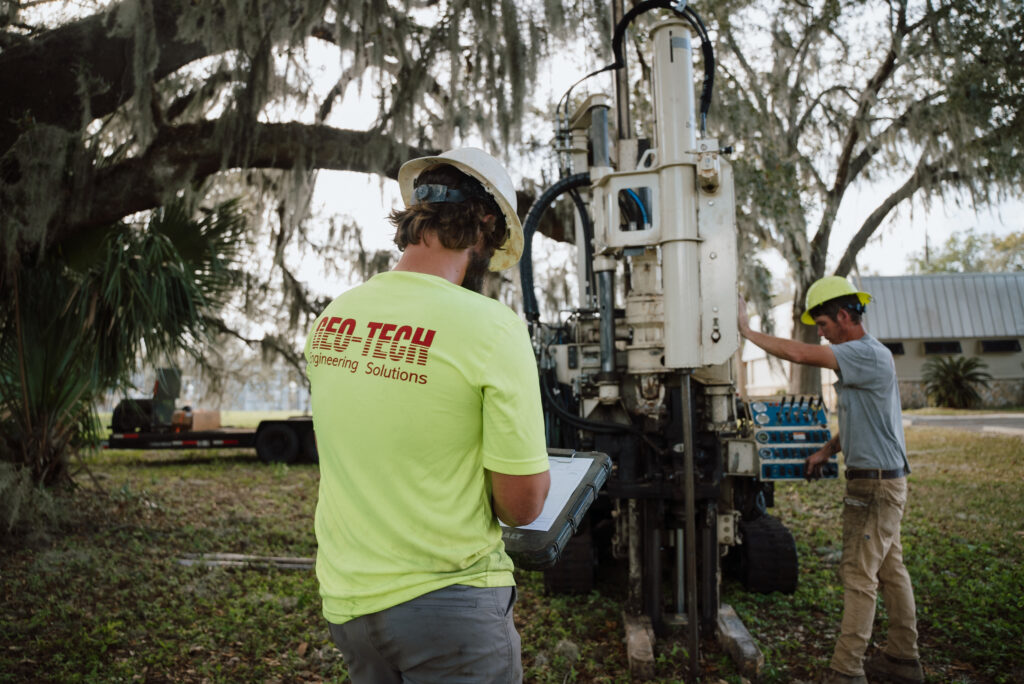
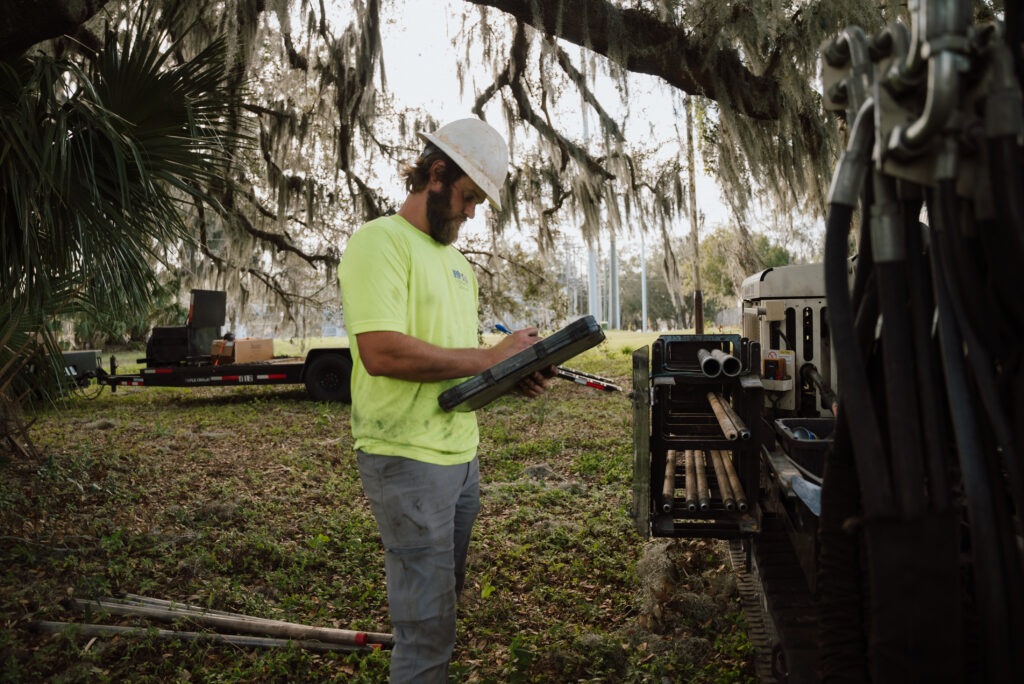
Geo-Tech runs percolation and field permeability tests using our seven track-mounted direct-push rigs, paired with auger borings and standard penetration testing to log the full soil profile. Our drilling services reach the layers that control drainage, and our field crews record how each stratum behaves so your engineer designs against reality instead of an estimate.
Why Soil Permeability Shapes Retention vs Detention Design
The pond type you can legally build depends directly on soil permeability. A retention pond relies on infiltration, so it needs soils that accept water and a water table low enough to give the pond somewhere to send it. When permeability is high and groundwater sits deep, retention is often the cleaner, cheaper choice.
Where soils are tight or the seasonal high groundwater rides near the surface, infiltration stalls and a detention pond, which stores runoff and releases it slowly through an outfall, becomes the safer design. The same test data also fixes your pond bottom elevation, because a bottom set below the wet-season water table will never drain. This is where accurate geotechnical engineering earns its keep.
Seasonal High Groundwater and Florida Permitting
Florida stormwater permitting runs through the regional water management districts, and they will ask for the numbers behind your design. Recovery time, treatment volume, and the seasonal high groundwater elevation all have to be documented, and all of them trace back to soil permeability and a defensible groundwater survey.
The Florida Department of Environmental Protection, together with the districts, sets the framework these calculations follow. You can review the state stormwater program through the Florida Department of Environmental Protection. Reviewers do not accept assumed values here. They want measured rates and a documented wet-season water table, tied to borings on your parcel. Our field permeability testing and groundwater and elevation surveys give your engineer the exact inputs a reviewer expects, which keeps your application moving instead of bouncing back for more data.
What It Costs to Get Soil Permeability Wrong
When soil permeability is overestimated, the pond is built too small or too shallow for the ground it sits in. It fills faster than it drains, standing water lingers for days, mosquitoes and algae move in, and banks erode. In a wet Central Florida summer, that failed pond can flood roads, lots, and the homes downstream.
The fix after the fact is far more expensive than the test would have been. Redesign, re-excavation, new permits, and lost schedule all stack up, and a contractor who signed off on the original grade may be the one holding the bill. Confirming soil permeability early, with laboratory support from our materials testing laboratory, is the cheapest insurance your stormwater system will ever buy.
Our Field Permeability Testing Process
01
Site review and boring layout
We study your site plan and pond footprint, then place borings where the drainage answers actually matter.
02
Drilling and soil profiling
Our direct-push rigs advance borings and log every layer, from surface sand to clay seams and limestone.
03
Field permeability and groundwater testing
We run percolation and field permeability tests and record the seasonal high groundwater elevation.
04
Reporting for design and permitting
You receive documented rates and elevations your engineer and the water management district can rely on.
Stormwater testing is worth ordering early whenever any of these conditions apply to your project:
- New retention or detention pond design
- Sandy or organic soils on site
- Suspected clay lenses or tight subsoils
- Seasonal high groundwater near grade
- Karst limestone or sinkhole-prone terrain
- Water management district permit submittal
- Subdivision or commercial site development
- Roadway and parking lot drainage
- Failed or slow-draining existing ponds
- Marion, Lake, Sumter, or nearby counties